


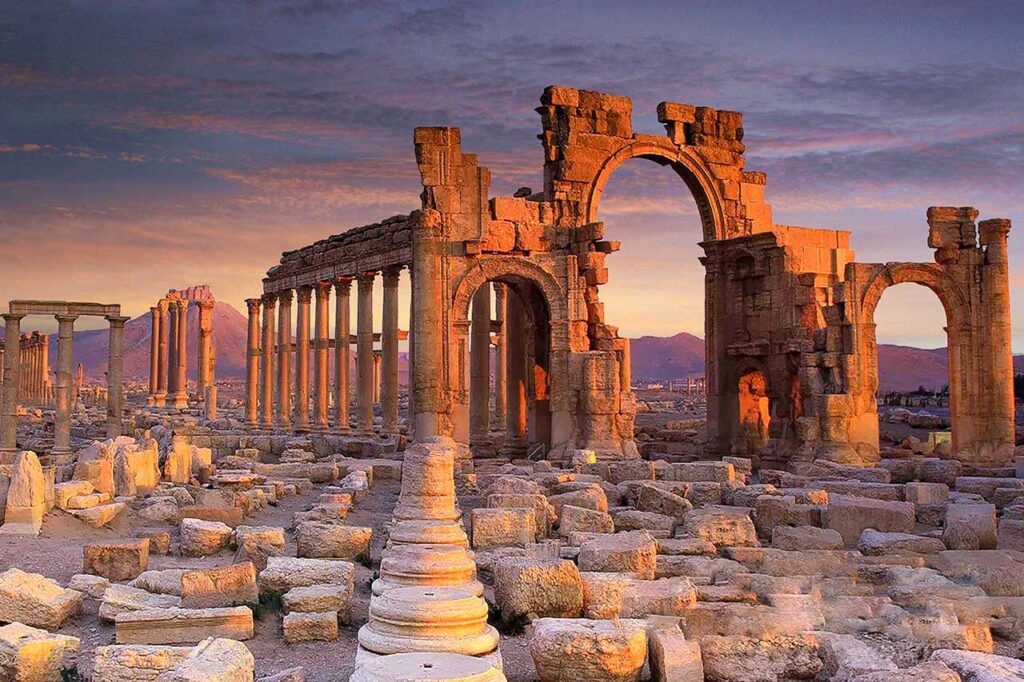
Palmyra and the Syrian Desert: Where the Silence Speaks
There is a particular quality to the light in the Syrian desert, in the hour before the sun finally gives up its hold on the day, that no photograph has ever quite managed to carry away intact. It falls across the ruins of Palmyra and the Syrian desert surrounding them not as illumination merely, but as a kind of slow unveiling — as though the stones themselves had been waiting, patiently, for someone to notice them again. This is not a journey like the others in Syria. Here, nothing competes with the clamour of cities; a whole empire stands alone in the vastness, telling its story to whoever cares to listen. With Safarji, we take you into the heart of the Syrian desert, to Palmyra, where history and silence and sand meet in a scene that exists nowhere else on earth.
Why Palmyra and the Syrian Desert Are Worth the Journey
Tourism in Palmyra and the Syrian desert differs from anything else in the country, if only because what awaits you is not a single monument but an entire ancient city, risen whole out of the sand. More than two thousand years ago, Palmyra sat astride the Silk Road, a meeting point of caravans and currencies, growing rich on its position between East and West. What remains — the broken columns, the paved avenues worn smooth by centuries of footsteps — offers a rare sensation: the feeling of standing, quite literally, in the presence of time itself.
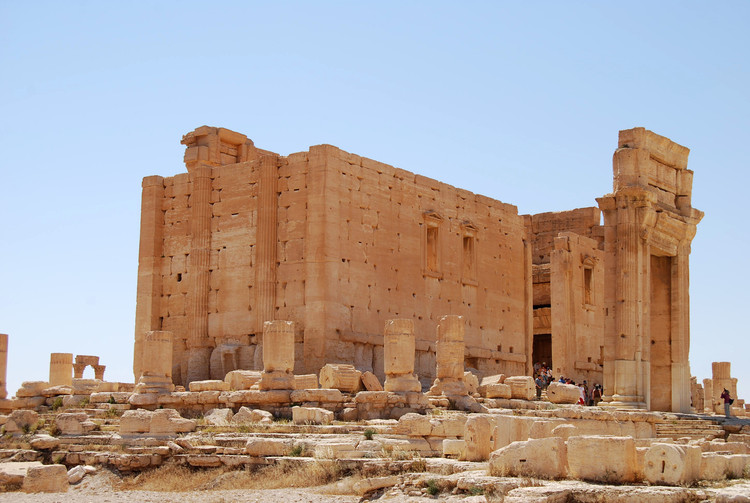
The Great Ruins of Palmyra
The ancient city holds architectural treasures that have few equals anywhere:
- The Temple of Bel: Once among the grandest temples of the ancient Near East. Though it bears the scars of damage, the site still carries a weight — almost a gravity — that is worth the visit alone.
- The Great Colonnade: Stretching through the heart of the city, it gives you, better than any book could, a living sense of just how ambitious Palmyrene urban planning truly was.
- The Monumental Arch: An elegant piece of architecture joining two sections of the main avenue, and perhaps the single most photographed corner of the entire city.
- The Roman Theatre: Reasonably well preserved, it once hosted performances and public gatherings in the Roman era, and still seems, somehow, to be waiting for an audience.
- The Valley of the Tombs: A collection of singular funerary towers, once used to bury Palmyra’s wealthiest families — a burial custom quite unlike anything found elsewhere.
Qalaat Ibn Maan: A View Above Time

On a hill overlooking the entire ancient site stands Qalaat Ibn Maan, a fortress from a later Islamic era. Climbing up, particularly as the sun begins its descent, rewards you with one of the finest panoramic views in all of Syria — the long shadows of ancient columns merging, slowly, with a sky that seems to change its mind about its own colour every few minutes.
Queen Zenobia: The Legend That Refuses to Fade
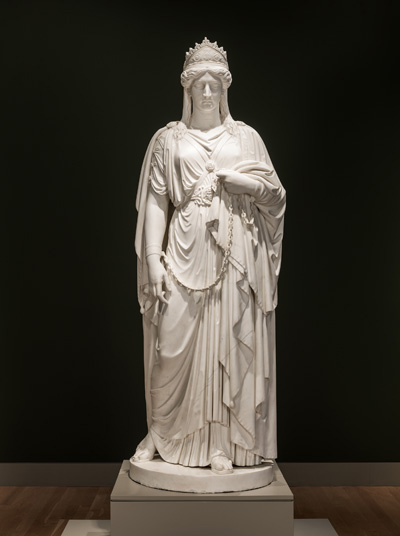
One cannot speak of Palmyra without Queen Zenobia, the ruler who led a rebellion against Rome itself and sought to carve out an independent empire stretching from Egypt to Anatolia. Her story — ambition, resistance, and eventual defeat — still lingers in every corner of the city, lending any visit here a human, almost epic, dimension that mere ruins alone could never supply.
Beyond the Ruins: Experiencing the Syrian Desert
No visit to Palmyra and the Syrian desert is complete without the desert itself. The badia surrounding Palmyra stretches for hundreds of kilometres, offering an experience unlike any other destination in Syria:
- Desert safaris: By four-wheel drive, exploring sand dunes and rock formations found nowhere else.
- A night beneath the stars: An unforgettable experience in traditional Bedouin tents, far from any light pollution, where the sky reveals itself in full.
- Bedouin hospitality: A chance to glimpse a way of life that has kept, remarkably, much of its original character — from the ritual of Bedouin tea to the bitterness of the coffee that follows it.
The Best Time to Visit Palmyra and the Syrian Desert
Spring (March–May) or autumn (September–November) are the seasons most worth choosing, when daytime temperatures are mild enough for long hours among the ruins. Summer brings considerable heat by day, but becomes, after dark, something closer to magic — for those willing to spend a night in the desert beneath a sky unlike any you will have seen before.
A Suggested Day and a Half in Palmyra
- Day One: Arrival in Palmyra, a tour of the ancient city (the Temple of Bel, the Great Colonnade, the Roman Theatre), followed by a climb to Qalaat Ibn Maan at sunset.
- Morning of Day Two: A short desert safari through the surrounding badia, with the option to extend into a full day for those wishing to spend a night under the stars.
Safarji’s Services for Your Trip to Palmyra
We arrange a complete journey to Palmyra and the Syrian desert, including private transport from Damascus or Aleppo with drivers who know the desert roads well, along with arrangements for a desert overnight stay for those who wish it. Get in touch through our website (syriatourism.net), and let us plan an unforgettable journey into the heart of history.
